
Imperial College London
2025 — 2026
MSc Advanced Computing as an Aker Scholar. Working on representation geometry in grokking and on generative models, supervised by Tolga Birdal.
Machine learning research · London
I work on why neural networks learn what they learn — the geometry of internal representations, when generalization actually arrives, and how generative models move noise into data. Currently an Aker Scholar finishing an MSc in Advanced Computing at Imperial College London.
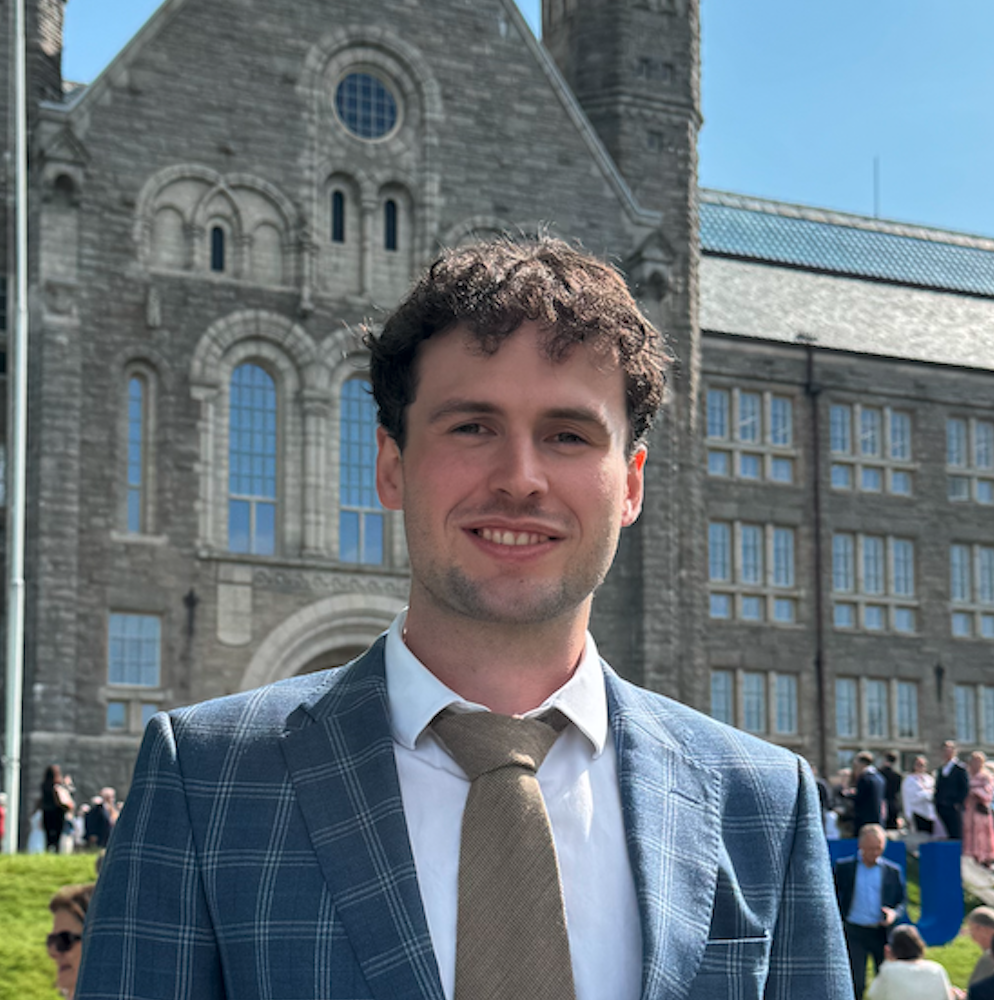
MSc Advanced Computing as an Aker Scholar. Working on representation geometry in grokking and on generative models, supervised by Tolga Birdal.

Fulbright Scholar in Mathematics at MIT, and a year with the Rajan Lab at Harvard building deep RL simulations to model animal behaviour.

Five-year integrated MSc in Mathematics. Thesis on continuous attractor networks and memory in deep reinforcement learning.
Persistent homology, intrinsic dimension, and the manifolds representations live on.
Generative models, generalization, and deep reinforcement learning with memory.
Grid cells, continuous attractors, and spiking models of biological memory.
JAX on GPU clusters, large-scale simulation, and numerical methods in C++.
Geometric statistics move sharply when networks grok, but a global measurement cannot say what moved. Writing each activation as a class centroid plus a within-class residual and intervening on the components separately shows that MST-based PH-dimension is driven largely by the centroid configuration, while TwoNN goes invariant once its neighbours fall inside classes — so the two estimators can assign opposite meanings to the same representational transition.
Can you tell a network is about to generalize without ever looking at test error? Tracking intrinsic signals of the internal representations — correlation dimension, PCA participation ratio, persistent homology and MST-based fractal dimension — first-layer MST dimension leads the generalization gap by roughly 1000 epochs. A parametric onset predictor recovers grokking time from those dynamics alone (R² ≈ 0.98). Selected to present at the Imperial Department of Computing ISO Conference.
Ongoing thesis work combining TarFlow — an autoregressive normalising flow over image patches — with Transition Matching. Instead of predicting a single deterministic direction the way flow matching does, the flow models and samples from the full distribution of plausible transition directions, keeping exact likelihoods while generating inside a single model.
Two agents can earn the same return while solving the task in completely different ways, so a reward curve says almost nothing about what a policy has learned. We show that model-free agents display implicit planning in open-ended environments, and introduce a behavior-analysis toolkit that reveals how policies reason and generalize.
Grid-cell activity lives on a torus: two periodic phases that a moving agent has to integrate. I built biologically inspired RL agents with LSTM memory and continuous attractor networks, designed analytical and numerical grid-cell modules in JAX, and analysed statistically how that toroidal structure appears in recurrent memory.
An empirical study of norm-based generalization bounds in CNNs under varying data sizes, random labels and optimization strategies — showing when tighter bounds actually say something useful, and how mini-batch size and regularization move the picture.
A digital learning platform for scientific courses with roughly 10,000 users. Led development of an interactive math-visualization library on top of Three.js.
LLM intern at a venture capital firm scaling Norwegian technology companies. Built a LangChain-based chatbot that returned verified sources to support investment and organizational decisions.
Built predictive rent-price models in Python at Europe's second-largest residential real estate company.
Built functionality and algorithms for analysing geospatial satellite data with Django, GeoPandas and SQL, supporting renewable energy projects.
Led development of the flight simulator for a student-built rocket that placed 2nd of 75 teams at the Spaceport America Cup 30K COTS. C++ and computational fluid dynamics.
Norway's most prestigious graduate scholarship, fully funding advanced studies at leading global universities.
One of six candidates selected for the non-degree Fulbright fellowship, spent at MIT.
Reached the national finals, ranking among Norway's top high school physics students.